
Describe your image

Describe your image

Describe your image
Describe your image
Our ASO Journey:
Hope, Hardship, and One Big Breakthrough
If you’ve just gotten your child’s genetic diagnosis, you might be feeling overwhelmed, hopeless, or completely lost. That was me, too. This page is for you.
Diagnosis: The Start of a Long Road
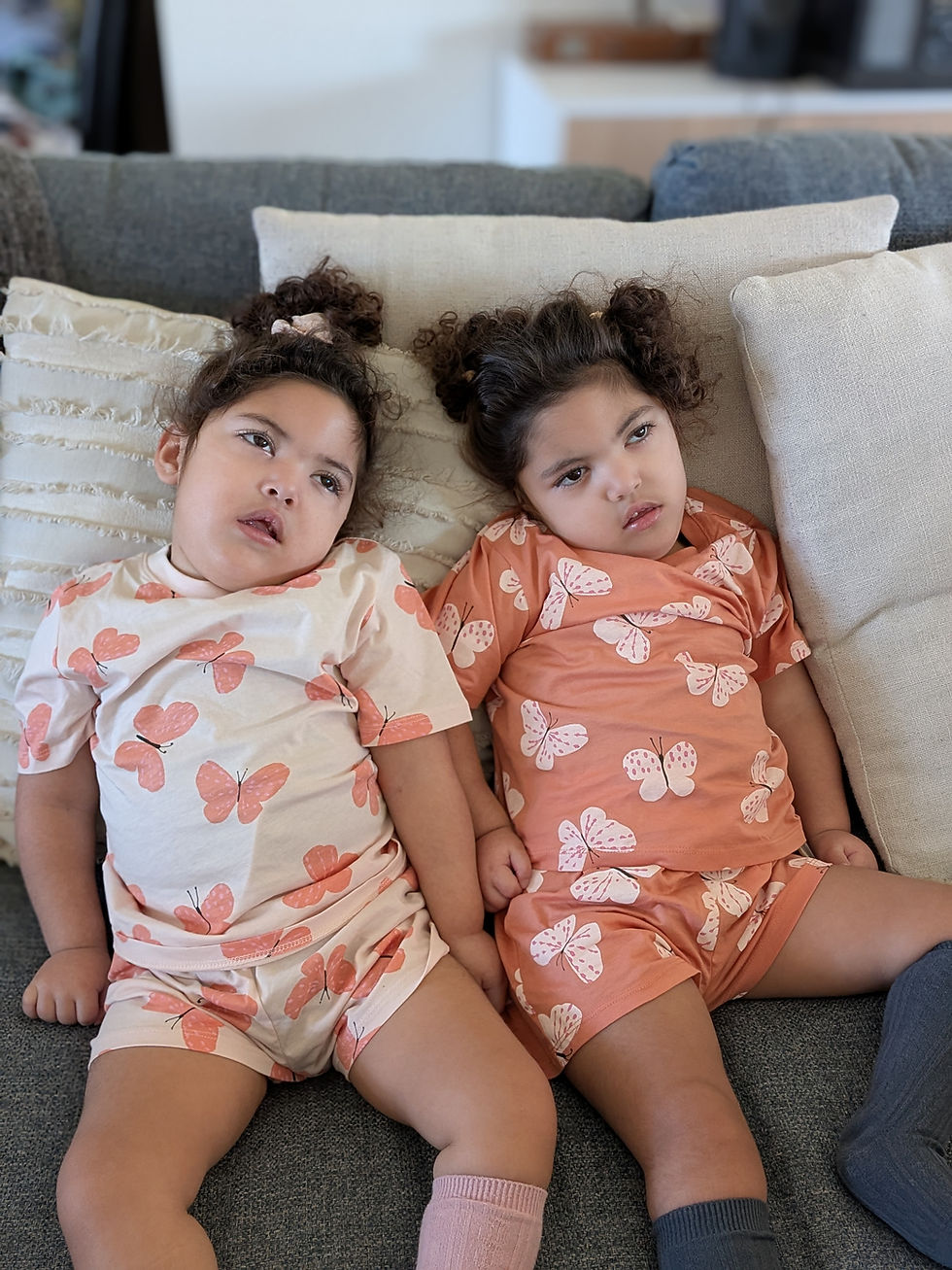
Our twin daughters were diagnosed with a rare mutation in the SPTAN1 gene — a condition with limited information, no approved treatment, and no roadmap.
We did what so many rare-disease parents do:
-
Googled frantically
-
Met with specialists who shrugged
-
Tried therapies, supplements, and medications
-
Grieved the life we thought we were going to have

Learning About ASOs
Eventually, I stumbled onto the concept of antisense oligonucleotides (ASOs) — customized genetic therapies designed to silence or correct specific mutations.
But I had no idea:
-
How to know if my kids were even candidates
-
Where to begin
-
Whether it was science fiction or something real
What is an ASO?
An antisense oligonucleotide, or ASO, is a small piece of synthetic genetic material designed to attach to a specific part of a person’s RNA—the instructions the body uses to make proteins. Think of it like a custom-made patch that sticks to a specific sentence in those instructions and changes how it's read. By doing this, ASOs can turn off a faulty gene, help the body make more of a missing protein, or fix how a gene works. Scientists use ASOs to target rare diseases caused by specific genetic mutations, offering a highly personalized form of treatment.
Getting Help
We were so fortunate to be connected with a research team at Baylor College of Medicine in Houston, Texas through a family connection.
We presented our situation, our twins' diagnosis, and they told us they would be able and willing to:
-
Use fibroblasts from our twins
-
Attempt to design an ASO specific to our daughters' DNA
-
Move forward towards possible clinical trials
Their participation gave us our first glimmer of actual hope — not just symptom management, but a possible root-level intervention.

Discovering n-Lorem
We learned about n-Lorem Foundation, a nonprofit that develops free, individualized ASO treatments for patients with ultra-rare diseases.
They focus on:
-
Patients with mutations unique to them
-
ASOs tailored to specific gene errors
-
No cost to families
Their work gave us the idea to bring our team at Baylor together with n-Lorem to help streamline our process and get to treatment more efficiently.
Getting an antisense oligonucleotide (ASO) treatment for a child with a rare disease can feel overwhelming, but it is becoming more possible thanks to advances in science and the dedication of families, doctors, and researchers. Here’s a simple overview of how the process works:
First, the child needs a confirmed genetic diagnosis. This usually involves genetic testing to find the exact mutation causing the disease. If the condition is caused by a single faulty gene, there’s a chance an ASO might help.
Next, families often work with doctors, scientists, or medical centers that specialize in rare diseases. These experts can figure out if the mutation might respond to an ASO. If so, a custom ASO can be designed in a lab to target the specific mutation and hopefully change how the gene works in the body.
Because this type of treatment is still experimental, it usually requires special permission from the FDA or other health authorities. Some families turn to nonprofit organizations like the n-Lorem Foundation, which provides ASOs for patients with ultra-rare diseases at no cost.
It can take months (or longer) to move through the steps—gathering medical records, working with researchers, and finding funding if needed. But even though the road is hard, more and more families are making progress toward treatments that didn’t exist just a few years ago.
In short: it starts with a diagnosis, builds with expert support, and grows with persistence, community, and hope.
Applying to n-Lorem
This wasn’t an overnight process. For others navigating this path, here’s what we learned:
-
You’ll need a precise genetic diagnosis.
-
A variant of uncertain significance (VUS) isn’t enough.
-
You’ll need confirmed pathogenic or likely pathogenic mutations.
-
-
You need a clinician partner.
-
Applications must come from a medical provider (often a geneticist or neurologist).
-
Ours was willing to collaborate and submit on our behalf.
-
-
You’ll be asked for medical records, genetic reports, and functional info.
-
It’s not easy, but you don’t need to have it all figured out to begin.
-
-
Wait. Hope. Breathe.
-
The review process takes time.
-
Not every application is accepted — and that’s a heartbreak I don’t take lightly.
-


Our Daughters Were Accepted
Recently, we were notified that n-Lorem accepted our daughters into their program to create a custom ASO therapy. Along with our daughters, the accepted two other SPTAN1 children with their variant.
We’re early in the process, but with the work Baylor has been doing for the past 2 years, we hope to expedite our goal of a functional and safe ASO. There are still unknowns — but we have real hope that a treatment specifically for them is in the works.
We know how rare this is. We’re grateful, amazed… and still trying to process it all.
The Guilt We Carry
With the joy comes guilt — for the families still waiting. For the ones who were told no. For the children lost before help could come.
That’s why we’re committed to:
-
Sharing what we’ve learned
-
Helping other families start the process
-
Advocating for wider access to ASOs for more children
Want to Explore ASOs
for Your Child?
Here are some next steps we recommend:
1. Confirm Your Child’s Mutation
You’ll need a full exome/genome report, with a pathogenic or likely pathogenic variant.
2. Learn More About ASOs
Start with these resources:
-
Zebronkysen: U-M researchers develop a personalized RNA therapeutic used to treat twins with an ultra-rare form of Batten disease.
3. Talk to a Clinician
If your child’s doctor doesn’t know about ASOs, that’s normal. Ask to be referred to a neurologist or geneticist who works with rare neurodevelopmental disorders.
4. Ask About Submitting to n-Lorem
If your child might qualify, your clinician can review n-Lorem’s submission guidelines.
Need Support? Reach Out
I can’t offer medical advice, but if you’re starting down this road and need someone who’s been there — I’m here.
For the Rare
This is for every parent staring at a four-letter gene they’d never heard of until their child got sick.
For every doctor who says, “There’s nothing we can do.” For every kid who deserves a treatment — even if they’re the only one in the world who needs it. We’re in this together.